



An international executive recruitment agency on Aquis is building its Bitcoin treasury position through earned fees, a Bitcoin-denominated convertible program, and accretive equity issuance - while the market prices only half of what Scott Ellam has built. A close look at the XCE treasury model, and where it sits in the UK ecosystem.
This is the second of a BitcoinTreasuries.net series deep diving into the companies building the British Bitcoin ecosystem.
Two Investors Look at XCE and See Half a Company
Scott Ellam has noticed something about the people who study his business. They split into two camps, and each camp sees a different company.
"I speak to Bitcoin investors, and they focus on the Bitcoin treasury," Ellam told BitcoinTreasuries.net "And then I speak to traditional investors, and they focus on the operating business, and their bias is to think that the operating business is the only way to fund the Bitcoin treasury, and the Bitcoin treasury investors feel biased to think that the Bitcoin treasury is the only way to strengthen the Bitcoin treasury."
Connecting Excellence Group plc, listed on the Aquis Growth Market as XCE, is a public listed operating business built on a profitable, international, scalable executive-search firm, Spencer Riley, with an integrated Bitcoin treasury sitting above it. The structure is deliberate: the treasury is held at the topco, so the Bitcoin belongs to every shareholder rather than to the subsidiary that earns the cash. What it produces is a two-way loop. A stronger operating business lends strength, credibility and durability to the treasury, which makes the treasury more attractive to the market, which in turn makes the group more attractive to the next revenue generating recruiter and the next cashflowing acquisition as they progress in their strategy of rolling up competitors and people into the group. Ellam calls it "a compounding model between operating business and balance sheet." The half that both camps tend to miss is that the two sides drive each other, and the routes that matter most to this readership are the ones that grow the stack without issuing a single new share.
A Private Treasury, Then a Public One
The listing is recent. The treasury is not. The reasoning behind it is the part worth dwelling on, because it is a treasury thesis rather than a conversion story.
Ellam founded Spencer Riley in 2014 and spent the next six years building a cash reserve inside the business, holding it deliberately for an opportunity to scale. The opportunity arrived in 2020, when he moved the firm to Leeds - the centre of UK international executive search - intending to recruit billers out of the larger firms around him. Lockdown landed a week later, and the central banks' response reframed the entire balance sheet. "The cash reserve that we'd been building I could see was now going to be debased and was going to draw down in purchasing power over the next 5, 10, 15 years," he said. "So in 2021, in October, I committed the business to a Bitcoin balance sheet." The reserve he had built for six years to deploy into growth became the reason to hold Bitcoin instead of sterling.

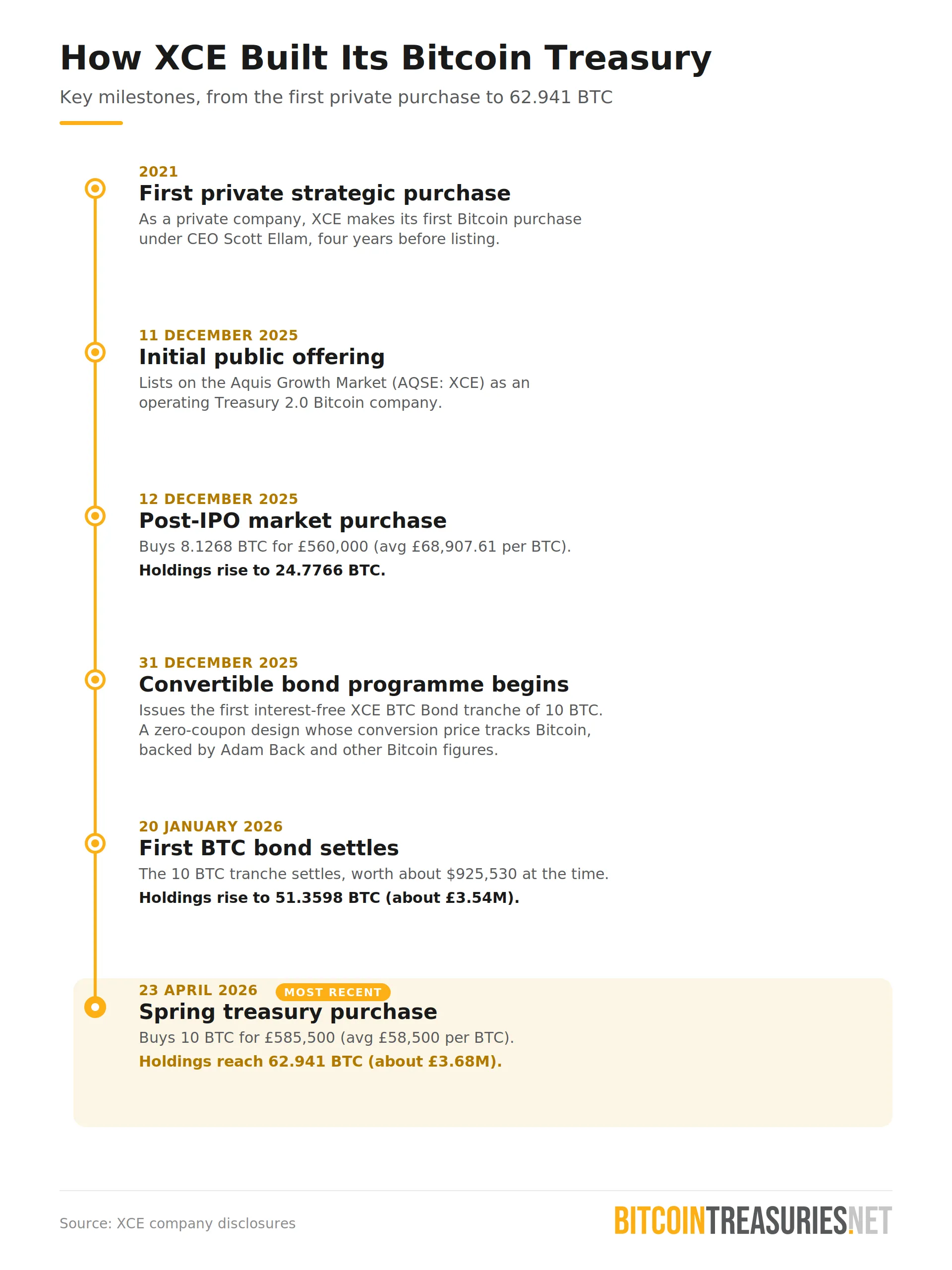
The first balance sheet Bitcoin purchase went through in October 2021, giving the company a four-year accumulation record through the deepest part of the cycle before any share traded. For most of that period the balance sheet was a private competitive advantage, run anonymously. What turned the private treasury into a public one was watching another UK company map the regulatory route first. When Smarter Web listed, the path cleared. "They've cleared a path through the regulatory woods that allowed me to follow, with significantly reduced risk to the existing operations," Ellam said. "Now that has been cleared, I can go for it." XCE - Connecting Excellence Group was incorporated in May 2025, acquired Spencer Riley in September, and listed on the Access segment of Aquis on 11 December 2025. XCE was oversubscribed and raised £3.3m gross at roughly an £8m valuation. A US OTCQB quotation under XCELF followed in February 2026.
The board is built for the capital-markets work the model depends on. Chairman Sam Roberts is a qualified actuary who helped lead the first UK pension-scheme Bitcoin allocation at Cartwright. Richard Byworth, board adviser, runs a Bitcoin-denominated fund, carries deep convertible-markets experience, and designed the company's bond. Vijay Selvam, board member, is Chief Legal Officer at Elektron, Tethers mining business. Adam Back, key strategic investor and CEO of BSTR, has followed on through every round and, in April, increased his stake again.
Earned Fees Are the Channel That Doesn't Dilute
The operating business matters here for one treasury reason: it is designed to increase cashflow that converts into Bitcoin without touching the share count. And it earns that cash on a cycle entirely its own.
This is the strongest evidence for the model, and it is empirical. By Ellam's account, Spencer Riley grew revenue at a 37% compound annual rate between 2021 and 2025 - a stretch that contained an 80% drawdown in the Bitcoin price. The reason is structural: "executive recruitment is uncorrelated to the Bitcoin price." The cash engine kept compounding while the asset it buys fell by four-fifths, which is precisely the property a treasury wants underneath it. A pure-play vehicle accumulates fastest when markets are open and issuance is accretive, and stalls when they close. An operating business that earns through the drawdown keeps buying when the price is lowest. The uncorrelated cash flow is the mechanism that lets XCE accumulate counter-cyclically.
The economics of that engine are capital-light. Recruitment carries almost no fixed asset base, revenue scales with people rather than plant, individual recruiters generate revenue from their own clients and the business is sector and region agnostic in its scaling ability - a high biller can start tomorrow, in a new market for XCE and generate revenue the following week.
The incentive and retention mechanism is the part a pure-play treasury cannot replicate. Across the industry, recruiters are paid in salary and commission with no equity and no long-term incentive. XCE adds performance-linked options on top that are directly linked to the sales revenue an individual recruiter generates, long-dated over 5 years and only vesting when a recruiter has generated significant revenue and profit. So, it functions first as a lever to drive cash generation and increase Bitcoin per share, but it is also a compounding incentive and retention model no commission-only rival can match. The cash generated is earned from clients, not raised from the next investor, which is the distinction that separates this channel of acquiring from issuance.
The Fee That Settled in Bitcoin
On 14 April 2026 Spencer Riley invoiced and settled a search fee directly in Bitcoin - 0.516 BTC, around £27,472 - and kept it on the balance sheet rather than converting to sterling. The company believes it is the first UK-listed recruitment business to invoice and settle a fee in Bitcoin. The receipt took holdings to 52.941 BTC.
At today's scale this is a proof of concept, and it reads best as one. A fee banked in Bitcoin and retained grows Bitcoin-per-share with no issuance and no capital deployed - the purest version of the accumulation channel above. The lever it demonstrates compounds as corporate familiarity with Bitcoin spreads: a recruiter that can bank fees in Bitcoin accretes hard money to every share each time it places a candidate. The single settlement is small. The mechanism is the point, and it is repeatable.
The Bond That Dilutes Only on Outperformance
The most sophisticated instrument on XCE's balance sheet is the one least expected on a company this size: a Bitcoin-denominated convertible bond, designed by Byworth. The first tranche was issued for ten Bitcoin and settled entirely in Bitcoin.
The mechanism is in the conversion price. On a conventional convertible the strike is fixed in fiat, so the bond converts into equity once the share price clears a sterling or dollar level, regardless of what the underlying treasury asset has done. XCE's strike is denominated in Bitcoin and tracks it. Conversion only comes into the money when the share price has risen faster than Bitcoin itself, by a defined margin of roughly 20%. The consequence is a clean alignment between financing and performance. If XCE merely tracks Bitcoin, the bond does not convert, no shares are issued, and the company has in effect borrowed Bitcoin at a zero coupon for the term. If the equity beats Bitcoin past the hurdle, conversion occurs and the resulting dilution has been paid for by exactly that outperformance. Dilution becomes the reward for beating the asset on the balance sheet rather than the standing cost of carrying debt.
"It was the first time there's been a truly Bitcoin-denominated convertible bond, in that the conversion price tracked Bitcoin," Ellam said. He is precise about the lineage. He credits Capital B with pioneering Bitcoin-denominated convertibles and describes XCE's work as optimising on that template with the benefit of an experienced team and Adam Back as a regular sounding board for testing the structure. The contrast with the dollar-denominated convertibles that built the first wave of treasury balance sheets is the substance of the design: a Strategy-style convertible is a bet on the equity in dollar terms, while XCE's is a bet on the equity in Bitcoin terms, which is the unit its holders care about. For a Bitcoiner, the bond is a Bitcoin-denominated instrument with a free call on equity outperformance. For the company, it is financing that cannot dilute unless shareholders have already won.
The instrument is also built to absorb fiat demand without leaving the standard. The structure allows fiat-based investors to participate through mechanisms that switch into Bitcoin on receipt, so demand denominated in pounds still arrives on the balance sheet as Bitcoin. And the programme is staged rather than open-ended. Ellam wants the first tranche to convert precisely so the company can move on the next one - conversion clears the runway for a second issuance, which is how a ten-coin proof becomes a repeatable financing line as the balance sheet grows.
The bond sits inside a broader discipline tied to the company's premium to net asset value. When the shares trade at a healthy multiple of the underlying Bitcoin, accelerated placements buy more Bitcoin per share than they create in dilution, and issuing is accretive. When the premium compresses, the discipline is to wait. Adam Back's April subscription is the cleanest read on the equity: he took 33,457,143 shares at 1.75p, matching the prevailing mid-price rather than a discount, for £585,500 directed straight at the treasury. A strategic holder adding at market, rather than waiting for weakness, is a signal that needs no narration. Ellam is candid that the full equity toolkit becomes more powerful at scale , naming roughly £30m as the floor for a Main Market up-listing conversation and £50m as the level he would prefer. Smarter Web has already made the Aquis-to-LSE move, which turns that path from theory into precedent.
The Yield Is the Scorecard
The holdings trajectory is the hard anchor. The treasury has gone from 9.27 Bitcoin before the IPO to 63 Bitcoin, built through IPO proceeds, the uncorrelated operating cash flow described above, the ten-coin bond tranche, the Bitcoin-settled fee, and the Back subscription. Every one of those routes other than equity issuance lifts Bitcoin-per-share rather than diluting it, and the issuance that has occurred was structured to be accretive in Bitcoin terms. XCE reports the result as a Bitcoin yield of 0.98% quarter-to-date in the second quarter, 136% year-to-date and 442.2% since the IPO.
XCE Wants to Staff the Sector It Belongs To
XCE lists into a UK ecosystem that is small, crowded and unusually collaborative. More than a dozen UK-listed companies now hold or plan to hold Bitcoin. Smarter Web is the scaled vehicle, the only one TD Cowen has been willing to call that after its move to the LSE Main Market. Around it sits B HODL, Satsuma, Stack, Falcon Edge and others, each carrying a different operating business beneath the treasury because listing rules require one, which has produced a set of structurally distinct companies competing for the same pool of UK capital.
The UK operators compete for capital and, ultimately, for Bitcoin, but their interests converge on one thing - the regulatory and tax environment improving. That interest has a concrete object. The Property (Digital Assets etc.) Act, which received Royal Assent in December 2025, confirmed that digital assets such as Bitcoin can be held as personal property under English law, giving the sector firmer legal ground, while the FCA still classifies Bitcoin as high-risk and XCE itself remains unregulated. Asked for the single policy change he would make, Ellam's answer is blunt: "Remove capital gains from the currency that is Bitcoin." Treat it as money, in other words, not a chargeable asset disposed of at a gain. The ask is rooted in experience: he came up through what he calls punitive taxes on business owners, employees and directors, and reads a capital-gains charge on what he regards as a currency as a category error.
His wider point on policy is counterintuitive, and it is the more interesting half of the answer. A harsher environment, in his reading, speeds adoption. Private-business owners are pragmatic, and a debasing, heavily taxed backdrop sharpens the case for a Bitcoin balance sheet rather than weakening it. He also sees the ground shifting beneath the regulators. The professional class that sits between business and the state - the accountants, the auditors, the big four, the law firms - increasingly contains people who understand Bitcoin and argue for it, and in his framing they sit "downstream of regulators and talk upstream to the regulators." The treatment he wants is, on that reading, a question of when, not whether.
XCE's distinct position in this group is that it could place the people the rest of it needs to hire, and that the operating business doubles as an adoption channel. The company is building a dedicated Bitcoin recruitment division to match Bitcoin-literate executives with treasury companies, infrastructure businesses and the traditional firms now moving onto the asset. The deeper point is what recruiters are: every business leader in every market and jurisdiction speaks confidentially to an executive recruiter about their biggest challenges and their career and business ambitions. A recruitment network aligned with Bitcoin therefore reaches into the boardroom of almost every industry at once, which makes the operating business a vector for corporate adoption rather than only a cash engine for the treasury. Ellam reads the demand as a question of timing. "Once you've got the need and the urgency aligned, people will move into Bitcoin pretty rapidly," he said. "Right now there's a need, but there's not an urgency. That urgency is building."
The Five-Year Test
The case Ellam makes for the next five years is an operating one, not a price call. He wants XCE to disrupt executive search, grow EBITDA through hiring and acquisition, and earn a genuine equity multiple on that profit on top of its Bitcoin net asset value - the largest UK search firms trade at a mid-single-digit multiple of operating profit, and his pitch is that multiple plus a compounding treasury underneath it. "Where we want to see the business in five and ten years is disrupting our industry and driving increasing EBITDA with a multiple valuation, and an mNAV that is a multiple as a result of that," he said.
The route runs through acquisition as much as hiring, and the logic of the roll-up is grounded in a structural problem the rest of the industry cannot solve. Every privately owned recruitment firm faces the same three constraints: it generates cash that loses value over time, it cannot offer the equity needed to attract and keep its billers, and it has no exit, because the assets are people who can walk and neither trade buyers nor private equity reliably bid for them. The result, in Ellam's description, is owners who "work in their own company their entire career only to self-fund a management buyout." XCE turns each of those constraints into a reason to sell to it. An owner who joins the listed vehicle can switch both cash reserves and ongoing cash flows into Bitcoin, back their recruiters with performance equity, and build a stake toward an exit that did not previously exist. The acquisition universe is large: roughly thirty direct competitors operating internationally, more than 500 recruitment firms in the UK, and thousands globally, typically of five to fifty headcount, none with long-term equity to offer. XCE is, on Ellam's framing, "the only listed vehicle with a Bitcoin treasury backing those share options."
For now the test is visible in a single number that moves one way. The treasury holds 63 Bitcoin, the fees increasingly arrive in Bitcoin, the cash engine compounds on a cycle uncorrelated to the price, and the bond is engineered so that growth costs shareholders nothing unless they have already beaten the asset they own. The two investors Ellam meets each see half of it. The company is built on the half they are both missing.
Want more bitcoin treasury coverage in your search results? Add Bitcoin Treasuries as a preferred source on Google.