




Nine months after its debut, Strategy's Stretch preferred stock is exhibiting the price discipline and liquidity depth of a seasoned fixed-income instrument. The market is taking notice.
A New Instrument Finds Its Floor
When Strategy priced its Variable Rate Series A Perpetual Stretch Preferred Stock at $90 per share in July 2025, the market had no real template for what it was buying. STRC was the first U.S. exchange-listed perpetual preferred security issued by a Bitcoin treasury company to pay monthly dividends, and the first to incorporate a board-determined monthly dividend rate policy. Novel instruments take time to be understood. What has happened since is worth examining closely.
In less than nine months, STRC has done something rare: it has found its floor, held it, and attracted institutional-scale liquidity while doing so.
The Mechanism Working as Designed
Since launch, the variable rate mechanism has done exactly what it was designed to do - seven consecutive monthly increases from 9.00% to 11.50%, and the price has barely moved.
April marks the first month without a rate increase since launch. The mechanism has stabilised. So has the price.
Liquidity at Scale
Price stability means little without volume. Here the data is striking.
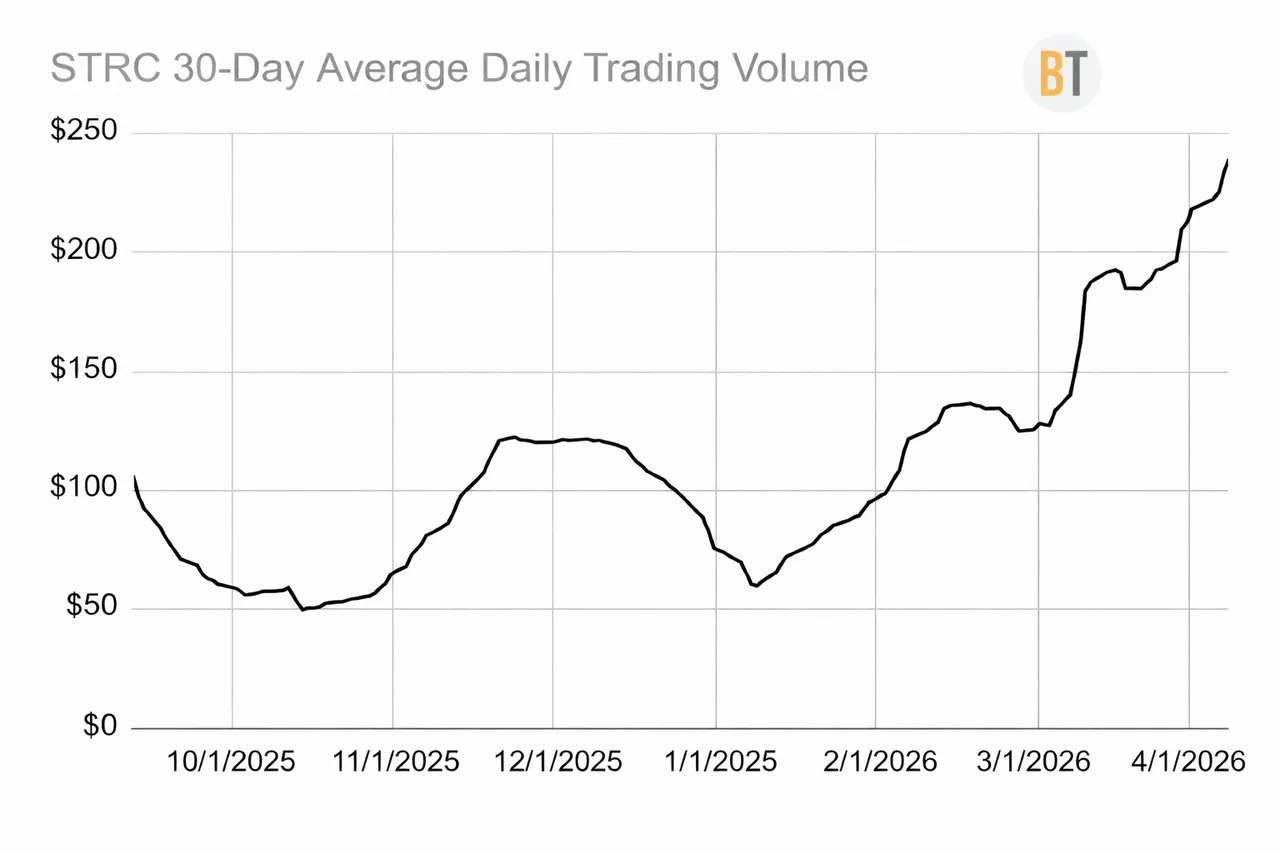
From lows of around $50M in October and November, STRC's 30-day average daily volume has climbed to approximately $240M today - a nearly fivefold increase in under six months. On April 10 alone, STRC traded roughly $526 million in a single session while remaining pinned at par. As Michael Saylor noted that evening: one penny of volatility, $526 million of liquidity, closed at par.
But the most telling comparison is not against STRC's own history. It is against the broader market.
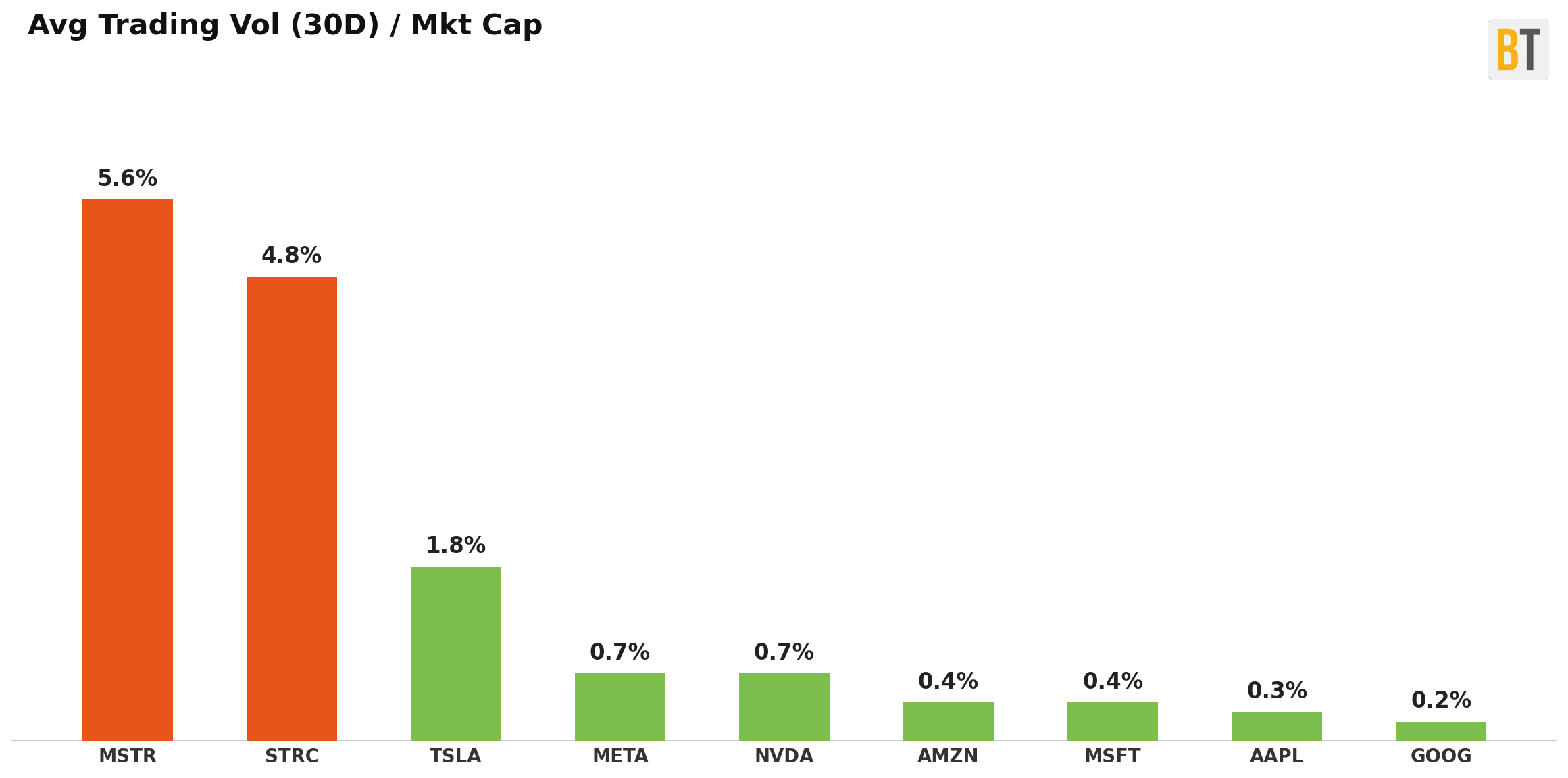
STRC's 30-day average volume as a percentage of market cap stands at 4.8% - behind only MSTR itself, and well ahead of Tesla at 1.8%, Nvidia at 0.7%, and Apple at 0.3%. For a preferred stock less than a year old, that is a remarkable figure. It represents genuine two-sided demand, not thin-market price management.
What Maturity Looks Like
Fixed-income practitioners know what a mature market looks like: tight price range, rising volume, predictable yield, and a growing investor base that understands the instrument's risk profile. STRC is exhibiting all four.
The investor composition tells its own story. Retail holders account for approximately 80% of the STRC float - more than double the 40% retail ownership in MSTR common stock. That inversion matters. It means the instrument has found genuine demand outside the institutional channels that typically absorb new preferred issuances. Retail buyers are not here because an allocation desk told them to be. They have done the analysis, understood the instrument, and made a decision. That is a different quality of holder than a captive institutional bid.
That breadth of ownership also has structural implications. A deeply retail-held instrument with nine-figure daily liquidity is harder to destabilise. There is no single large holder whose exit reshapes the book. The price stability STRC exhibits is not just a product of its yield mechanism - it is also a reflection of a distributed, conviction-driven holder base that has priced the instrument and is comfortable sitting at par.
Why This Matters Beyond Strategy
For decades, fixed-income markets have operated on a simple assumption: yield and stability are a trade-off. You can have high yield with volatility, or low yield with predictability. STRC is challenging that assumption directly.
An 11.5% annual yield, paid monthly, on an instrument that closed April 10 with a one-cent daily range is not something traditional credit markets have produced. The closest comparable instruments - high-yield bond ETFs, perpetual preferred securities from blue-chip issuers - deliver a fraction of that yield for similar or greater price variance.
Traditional credit markets have never produced that combination. It exists here because the architecture enforces it - and the market, at scale, is accepting it.
For institutional allocators watching from the sidelines, the calculus is shifting. A Bitcoin-backed instrument with nine-figure daily liquidity, a sub-penny volatility profile, and an 11.5% yield begins to look less like a novelty and more like a category. If that category develops, the implications for how fixed income is constructed, priced, and allocated could be significant.
The risk-adjusted picture is equally striking. STRC's highest Sharpe ratio stands at 5.37 - more than double gold's 2.36, and well ahead of QQQ at 0.98 and the S&P 500 at 0.85. Most asset classes spend careers trying to reach a Sharpe of 1. STRC has cleared it by nearly four times in under a year.

The Broader Implication
Strategy built STRC to fund Bitcoin acquisitions - but it has also created a proof of concept for an entirely new asset class. Bitcoin-backed credit, at par, with nine-figure daily liquidity, in under a year. The case no longer needs to be made theoretically.
The benchmark exists. The question is who builds on it.
Want more bitcoin treasury coverage in your search results? Add Bitcoin Treasuries as a preferred source on Google.